
Past papers and practice papers are one of the clearest ways to turn learning into exam readiness, especially when they are used with method and technique rather than last-minute intensity. They help learners understand how questions are set, how marks are awarded, and how to manage time with more consistency.
This matters across GCSE, IGCSE, A Level and equivalent pathways. The specifics can vary by exam board and school, but the preparation principles stay the same. A steady routine, clear technique, and thoughtful review tend to be more effective than doing a large number of papers quickly. Because one-to-one online tuition offers a personalized environment to build these habits, this guide explains a calm, structured approach that works well for families.
Contents
-
Why practice papers work
-
Choosing the right papers for your pathway
-
A five-step method that builds confidence
-
Using mark schemes in a useful way
-
A weekly routine that stays sustainable
-
How Greystone supports learners alongside school
-
FAQs
1. Why practice papers work
Strong practice paper work develops three things that sit behind exam performance.
-
First, application: When students understand what British learning standards look like in practice through regular review, they learn to apply knowledge to actual question styles rather than only revising notes.
-
Second, technique: They learn how marks are awarded, what examiners look for, and how to structure responses more clearly.
-
Third, consistency under time pressure: They build pacing gradually, so timing becomes familiar and manageable.
Evidence-informed classroom approaches often highlight the value of retrieval and regular review. Past paper work fits well when it is used in repeated cycles, with time to revisit and refine.
2. Choosing the right papers for your pathway
Before using any paper, make sure it matches what the learner is studying. This keeps practice aligned to school learning and avoids unnecessary confusion. Because UK-qualified tutors often have the deepest insights into board-specific requirements, you should start with four checks: exam board, specification, paper type, and official source.
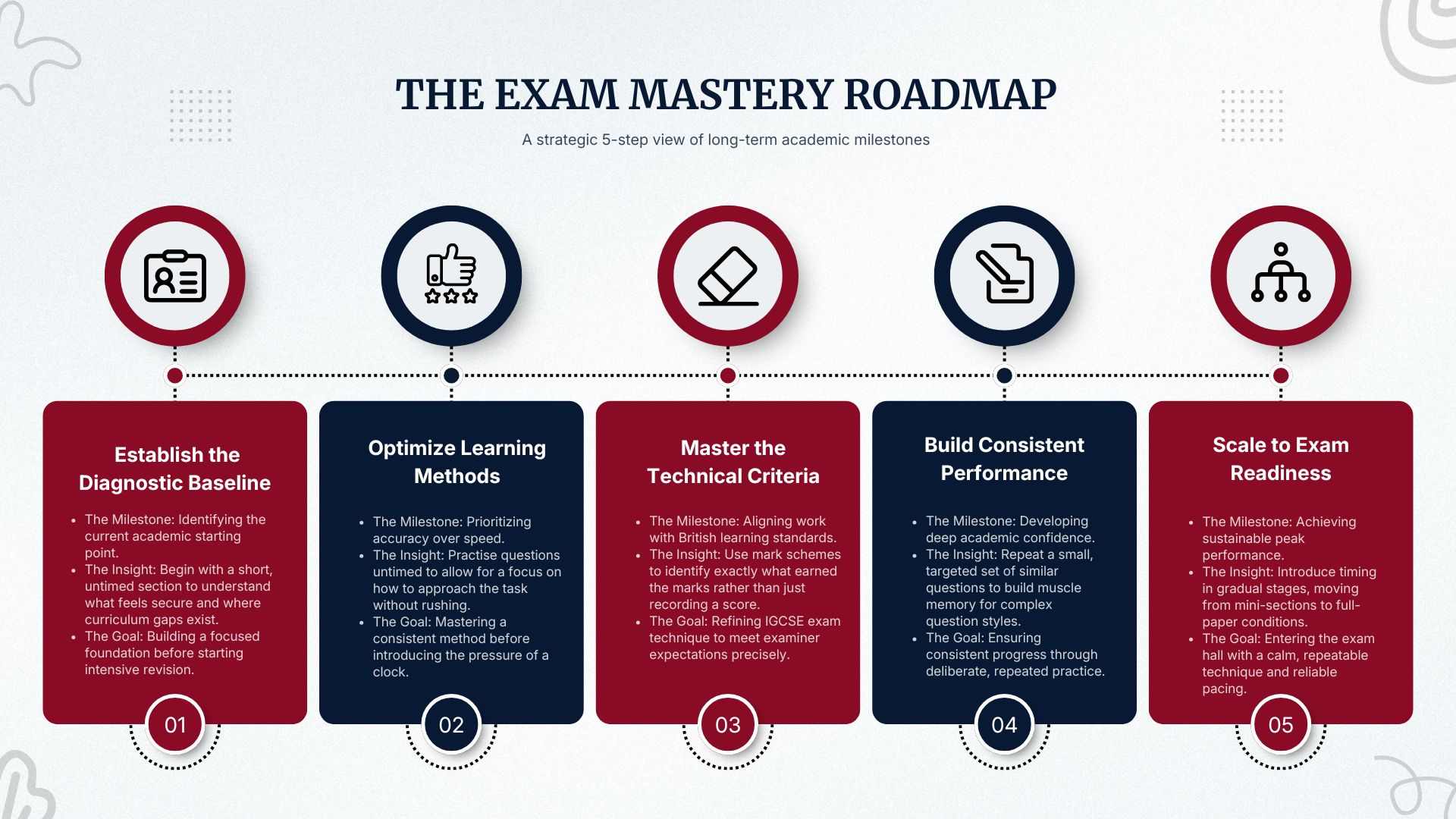
3. A five-step method that builds confidence
This approach keeps preparation steady and purposeful.
-
Step 1. Begin with a short baseline: Start with a section or a small set of questions to understand what feels secure.
-
Step 2. Practise untimed first: Untimed practice supports accuracy and method without the pressure of rushing.
-
Step 3. Mark and categorise what happened: Do not only record the score, but note if errors were due to knowledge gaps or technique.
-
Step 4. Repeat a small, targeted set: Working towards consistent progress involves practicing similar questions until the method is reliable.
-
Step 5. Introduce timing gradually: Once method is reliable, add time in stages to build confidence.
4. Using mark schemes in a useful way
Mark schemes work best when they teach technique, not when they are used to memorise wording. At Greystone Tuition, we believe a practical approach involves comparing the learner’s answer to the mark scheme to identify exactly what earned the marks. For Maths and Sciences, this often means showing the correct steps clearly, while for humanities, it involves building responses that match the required detail.
5. A weekly routine that stays sustainable
A calm routine is often easier to maintain than occasional long sessions. Many learners do well with a simple weekly rhythm that supports school learning:
-
One session for topic clarity to keep understanding secure.
-
One session for practice paper work to build pacing.
-
One session for review and next steps to refine technique.
6. How Greystone supports learners alongside school
The academic tuition provided by our team ensures that sessions are tailored to the learner and designed to support school priorities. For those with a stronger Mathematics, Sciences, or Computer Science focus, having access to specialized STEM tuition provides the necessary depth for complex topics.
As students move toward the end of their school journey, engaging in university tuition or seeking professional career support can ensure a smooth transition to the next stage. If you are looking for a tailored roadmap for success, please contact us to discuss a personalized plan with our academic team.
FAQs
1. When should learners start using past papers? A good time to start is once topics have been introduced in school. Begin with short untimed sections, then add timing gradually as technique becomes more consistent.
2. Should learners practise full papers or smaller sections? Both can help. Sections are useful early for method and accuracy. Full papers become more useful later when pacing and endurance matter.
3. How many past papers should a learner complete? There is no fixed number. A measured approach is to complete enough papers to identify patterns, improve weak areas through review cycles, and see steadier performance over time.
4. What is the most useful way to review mistakes? Look for patterns rather than isolated errors. Decide whether it was knowledge to revisit, method to refine, question interpretation to improve, or timing to adjust. Then set one clear focus for the next session.
5. How should mark schemes be used? Use them to understand what earns marks and how answers are structured. Rewriting a small number of responses with better structure is usually more effective than memorising wording.
6. How can past paper work stay aligned to school learning? Use the learner’s current syllabus, class topics, homework priorities, and school feedback to choose what to practise. Past paper work is most useful when it supports what is being taught in school.
7. Can one-to-one tuition help with past paper technique? Yes, when it focuses on method, question approach, and structured review cycles. The aim is consistent technique and calmer timing, not quick fixes.